PARSHIOT
Sovereignty Without a Sovereign
A devar torah for Parshat Shoftim
Read through Mordecai Kaplan and Harold Schulweis from a Spiritual Humanistic Jewish perspective
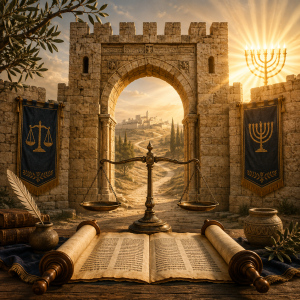
Ask a simple question of this week’s parsha and watch it come apart in your hands: from a Jewish perspective, is having a king a good thing or a bad thing?
The Torah says som tasim alecha melech — set a king over you (Deut. 17:15). Maimonides counts it among the 613 commandments. But look at what triggers it: “and you say, I will set a king over me, like all the surrounding nations.” Nowhere else does Torah legislate for the desire to be like everybody else. The whole vocabulary of kadosh runs the other way — set apart, distinctive, willing to be different.
And when Israel finally does ask, in Samuel’s day, God’s response is not “yes” and not “no.” It is: they have not rejected you, they have rejected Me — now go and give them what they asked for (I Sam. 8:7). The commentators split all the way down the line. For Maimonides a mitzvah, for Ibn Ezra a permission, for Abarbanel a concession to human weakness, for Rabbenu Bachya a punishment that carries itself out.
I want to suggest that the ambivalence is not a flaw in the text. It is the text’s actual teaching — and that reading it as a Spiritual Humanistic Jew makes it sharper rather than softer.
I. Turn the sentence around
Harold Schulweis proposed a small grammatical revolution he called predicate theology. Ordinary theology is subject theology: it starts with a noun — God — and hangs adjectives on it. God is just. God is merciful. God is compassionate. Everything then depends on first establishing the noun, which is exactly where so many of us get stuck, and so the adjectives never get their turn.
Schulweis said: reverse it. Don’t begin with “God is just.” Begin with justice is godly. Don’t begin with “God is merciful.” Begin with mercy is godly. The predicates are not speculative. We can find them, test them, recognise them in a hospital corridor or a courtroom or a kitchen at two in the morning.
As a Spiritual Humanistic Jew, I take Schulweis’s move one step further. Where he speaks of godliness, I understand holiness — the sacred.
Justice is sacred. Mercy is sacred. Compassion is sacred. Healing is sacred. Courage can be sacred. The dignity we protect in another human being is sacred. These qualities do not need a supernatural Person behind them in order to make a claim upon us. They are holy because of what they make possible between people and within the world.
So when traditional theology says that God is just or compassionate, I hear it as our ancestors’ way of naming justice and compassion as belonging to the realm of the sacred.
Now read God’s line to Samuel again. As subject theology it sounds like a wounded monarch, hurt that the people preferred someone else. Read through predicate theology — and then through a Spiritual Humanistic understanding of holiness — and it becomes a political diagnosis of surgical precision:
When a people moves its ultimate loyalty from a standard to a person, it loses the standard by which persons are judged.
A person can be flattered. A person can become frightened, vain, angry or corrupt. A person can change his mind at three in the morning.
Justice does not.
Ein lanu melech ela atah — we have no king but You — need not be a claim about who occupies a throne above the clouds. It can be a declaration that the throne of ultimate authority is occupied by no human being; that it is reserved for what we hold sacred: fairness, compassion, truth, human dignity, the protection of the widow and the orphan and the stranger.
And therefore it is permanently unavailable to anyone who wants to sit in it.
Israel’s king copies out a Torah he did not write and reads from it all the days of his life (17:19). The most radical image in our parsha is not necessarily an image of heaven. It is almost an image of constitutional restraint:
there exists a document the king may not edit.
Kaplan called the things a people holds sacred its sancta — the texts, days, practices and places through which a civilisation carries its ideals forward. Here the sancta does constitutional work. Torah places something above the ruler: an inherited standard against which the ruler himself must be judged.
II. The Power that makes for salvation
Kaplan would not let us define God simply as a supernatural being who intervenes from outside the world. God, he wrote, could be understood as the Power that makes for salvation — the forces within life, society, nature and ourselves that move us towards wholeness.
And salvation for Kaplan is not somewhere else and not sometime later. It is this-worldly: the possibility of becoming more fully human, more fully ourselves, and creating the social conditions in which other people can do the same.
Nobody reaches that kind of fulfilment alone. Personal salvation is inseparable from social salvation.
That means everything in Shoftim that looks like mere administration is actually part of the load-bearing structure of the spiritual life.
Courts in every gate. Judges who take no bribe. Two witnesses, never one. Cities of refuge, so that someone who killed accidentally is not simply consumed by a blood feud.
Tzedek tzedek tirdof — justice, justice shall you pursue (16:20).
Notice what the verse does not say. It does not tell us to pursue God.
It tells us to pursue justice.
Twice.
Because justice is not something we possess. It is something we chase. And because the pursuit itself must be just: the means cannot be corrupted in the name of the end.
For me, this is where Kaplan and Schulweis meet. The sacred is not a supernatural substance deposited into the world from somewhere else. It becomes visible in those forces and behaviours that make wholeness possible.
Holiness is not something we own.
It is something we enact.
III. Why the Torah refuses to settle it
So why the ambivalence about the king?
Because power is simultaneously the tool we cannot do without and the thing that can ruin whoever holds it.
Lord Acton — who wrote that the example of the Hebrew nation “laid down the parallel lines on which all freedom has been won” — is the same Acton who warned that power tends to corrupt.
And Judaism is not an argument for powerlessness. Jewish history makes that impossible.
It is an argument for power limited — no excess of horses, wives, silver or gold.
Power separated — the royal crown is not the priestly crown.
And power transformed:
l’vilti rum levavo me’echav — so that his heart is not lifted above his brothers (17:20).
The king remains a brother.
That may be one of the most important political words in the passage.
Kaplan famously argued that the past has a vote, not a veto. Here the past votes for a permanent argument rather than a settled answer, because the tension between “someone must be in charge” and “no one deserves absolute authority” cannot finally be solved.
It can only be managed, generation by generation, by people willing to keep managing it.
Jonathan Sacks offered a striking image for this. Mesopotamia built ziggurats and Egypt built pyramids: broad at the base and narrow at the top. The many hold up the one.
The menorah reverses the shape: narrow at the base and broad at the top.
But I think there is another detail worth noticing.
What stands at the top is not a ruler.
It is light.
The one exists to support the many, and the entire structure exists for something beyond itself.
That, for me, is what sacred authority looks like. Institutions are not sacred because they are powerful. Leaders are not sacred because they lead. Traditions are not sacred simply because they are old.
They become sacred when they carry light.
Rehoboam was told this in plain words and could not hear it:
If today you will be a servant to these people and serve them, they will be your servants always (I Kings 12:7).
Three times the language of service in a single sentence.
He heard weakness.
The kingdom split.
And we never fully recovered.
IV. A body in a field
And then look at how the parsha ends.
Not with kings.
With a corpse.
Someone is found killed in open country and nobody knows who did it (Deut. 21:1–9). The elders of the nearest town are made to go down to the valley, perform the prescribed ritual, wash their hands and declare:
our hands did not shed this blood, and our eyes did not see.
The biblical ritual speaks in the language of atonement before heaven. But the rabbis hear something else inside it as well.
They ask the obvious question: did anyone really suspect the elders of murder?
No.
The elders are being required to say something much more uncomfortable: that this person did not pass through their town hungry and unnoticed. That they did not allow him to leave without care. That they did not send him back onto the road entirely alone.
The ritual therefore becomes a technology for creating accountability precisely where ordinary law cannot reach.
No defendant.
No evidence.
No criminal case.
And yet leadership is required to stand publicly in the landscape where a human being died and acknowledge that a death within its sphere of responsibility is its concern.
That is predicate theology performed rather than argued.
Or, in the language I prefer: that is holiness made practical.
Nobody needs to speculate about what a supernatural God did or did not do.
The question becomes:
What would the sacred have required of us? What would compassion have required? What would responsibility have required? What would human dignity have required? Where did we fail to make those things real?
V. In all your gates
Shoftim always falls in Elul, and its opening words are perhaps the reason the timing feels like an accusation:
shoftim v’shotrim titen lecha b’chol she’arecha — judges and officers you shall appoint in all your gates.
The Hasidic masters read she’arecha as the gates of the self: the eyes, the ears, the mouth.
Every one of us is a small polity.
And the question this parsha asks the king it eventually asks each of us:
Is there anything in you that you are not permitted to edit?
Is there a standard you serve?
Or only standards that serve you?
For a Spiritual Humanistic Jew, that question becomes heavier rather than lighter because responsibility cannot simply be handed upward.
I do not understand holiness as something sent down from another world.
Holiness happens here.
It happens when justice becomes action. When compassion interrupts indifference. When truth costs us something. When another person’s dignity places a limit upon what we are prepared to do. When power bends itself towards service rather than demanding service for itself.
The sacred happens — or fails to happen — in the distance between what we could have done and what we actually did.
So when a leader serves rather than demanding to be served, I do not imagine God somewhere above watching approvingly.
I would say something different:
holiness is occurring.
That, for me, is the Spiritual Humanistic development of Schulweis’s predicate theology.
What he calls godliness, I call holiness.
What traditional theology locates in the character of God, I encounter in the sacred possibilities of human beings, human relationships and the world we build together.
To lead is to serve.
And the sacred is not primarily a noun we are asked to believe in.
It is something we are asked to make real.
Elul is when we ask ourselves whether we have.
Shabbat shalom.